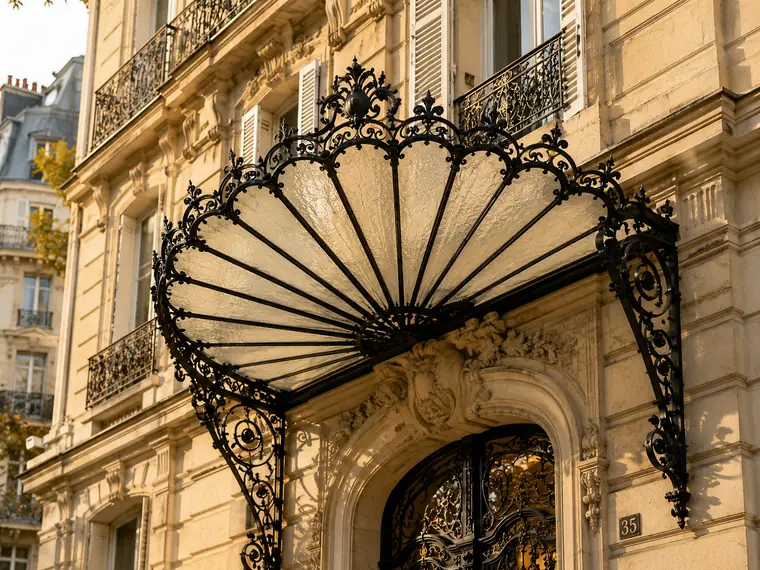
Belle Époque fan canopies — 1880–1914
The radiating fan is the canopy of façades with character: a half-rosette of iron and glass crowning a front door like a halo. Descended from the nineteenth-century station roofs, it comes in twelve models of the gesture that dressed Paris between 1880 and 1914.
Belle Époque fan canopies: our models
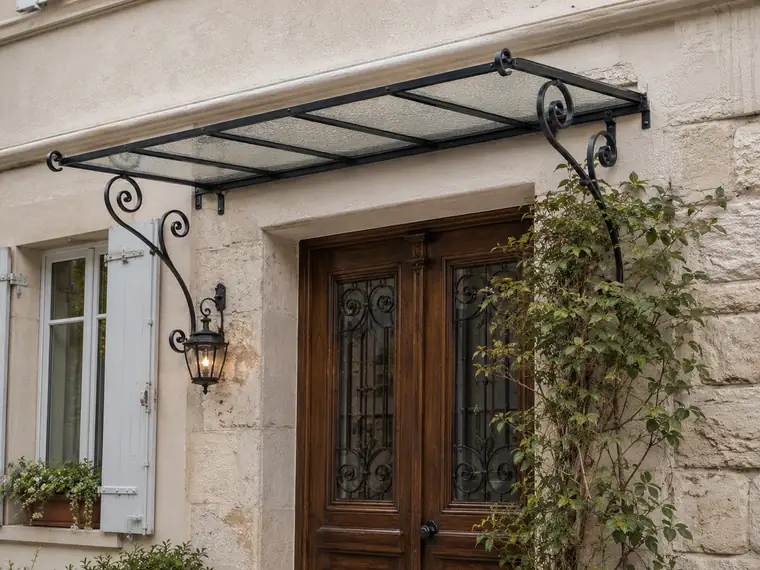
The fan, king of the Parisian canopy
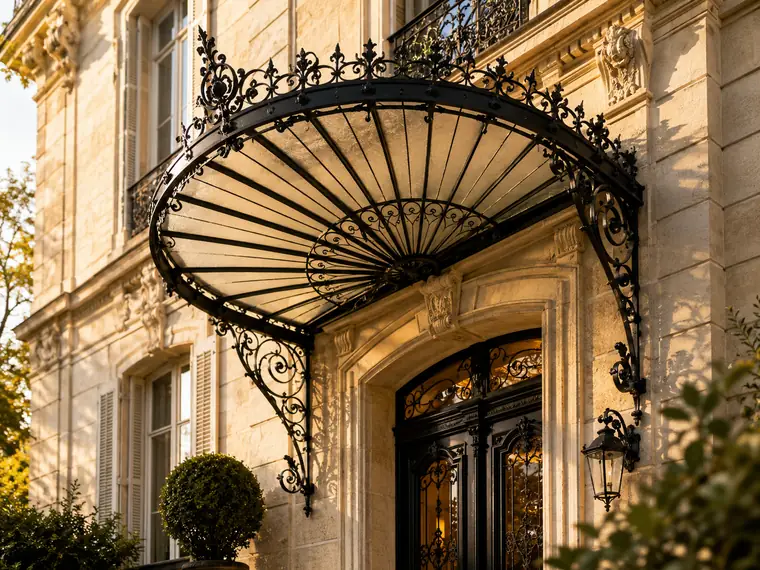
Between 1880 and 1914, Paris fills with fans: the technique of the great station roofs — Saint-Lazare, Orsay — comes down into the street and settles above the doors of town houses and tenement blocks. The principle is an engineer’s: solid iron ribs carrying the load of the glazing back to a common springing, and two S-scroll brackets holding the whole against the wall. The result is an artist’s: a half-rosette that catches the morning light.
Recognising a genuine fan
Three details separate a craftsman’s fan from a cold-bent industrial copy. The springing of the ribs, forged in one mass and never bolted. The scalloped edge, cut and then filed by hand, whose undulations are alive. And the brackets, whose section tapers towards the scroll. These are exactly the three points the Architectes des Bâtiments de France look at in protected areas in France — and the ones our reproductions respect.
Which façade it suits
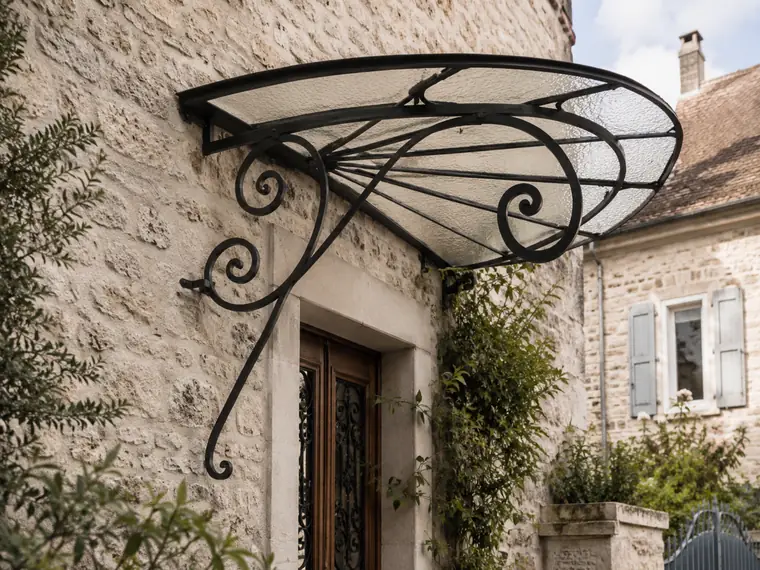
The fan calls for mouldings: cornices, string courses, dressed surrounds. It belongs on 1880-1930 façades, it lifts a manor house, it gives structure to a Haussmann block. On a very plain or rural building, the flat canopy is the truer choice; for a door on a street corner, see the corner canopies.
Belle Époque fan canopies: your questions
What does a fan canopy cost?
Can an antique fan be reproduced exactly?
Your door canopy, forged to your dimensions
One photograph of your door and its measurements: the workshop recommends the right model and prices it precisely. Free, no obligation.